

Most founders find the hard parts of subscription ecommerce after launch. Pricing tiers multiply, trials convert differently from paid renewals, customers ask to pause, a buyer turns up in a new tax region, and failed payments turn into churn.
So you aren't choosing a checkout widget for a side project. You're choosing the machinery that approves renewals, calculates tax, recovers failed cards, prorates upgrades and keeps customers' trust for years, usually while you're asleep.
A failed renewal shows the stakes. A customer who wanted to stay can lose access without ever choosing to cancel. Failed payments typically cause 20–40% of all churn in subscription software, and the median business recovers only about half of them.
Judge a platform by the failures you expect at your next stage, not by how simple the first checkout looks. Start with what a platform actually does, and the criteria that separate one from another will point you to the one that fits the kind of seller you are.
- Why does the platform choice matter more than ever?
- What does a subscription ecommerce platform do?
- The decision criteria that separate platforms
- Matching platform strengths to seller profiles
- Integrations, APIs, and developer experience
- Retention, recovery, and the new compliance layer
- Choosing your platform and next steps
- Hand off the legal sale and billing to Creem
Why does the platform choice matter more than ever?
A working checkout proves you can sell today’s subscription. Your next pricing change asks more of the platform.
Usage pricing needs consumption records. Prepaid credits need a balance that increases when customers buy and decreases as they consume. If a customer buys a credit pack but their balance never updates, you have collected payment without giving them usable credits.
Build your next planned meter or credit pack in the vendor’s test environment, because that change is where a balance that never updates first shows up.

A subscription platform runs the billing that follows the first charge.
The platform is part of your retention strategy
Billing-driven loss needs different treatment from deliberate cancellation. Your grace-period and entitlement rules decide whether a payment problem immediately cuts off access or gives the subscriber time to fix it.
Go through the customer portal as a subscriber: download an invoice, update the payment method, and count the clicks needed to find cancellation. Those are billing experiences your customers will have to navigate.
What does a subscription ecommerce platform do?
A subscription ecommerce platform handles checkout, scheduled charges, subscription records, and invoices. Your application controls product access: it checks the billing outcome and subscription state before granting the permissions that plan includes. If that update fails, the customer has paid and still sees the free tier.
The guide to billing for SaaS shows how these billing components fit together.
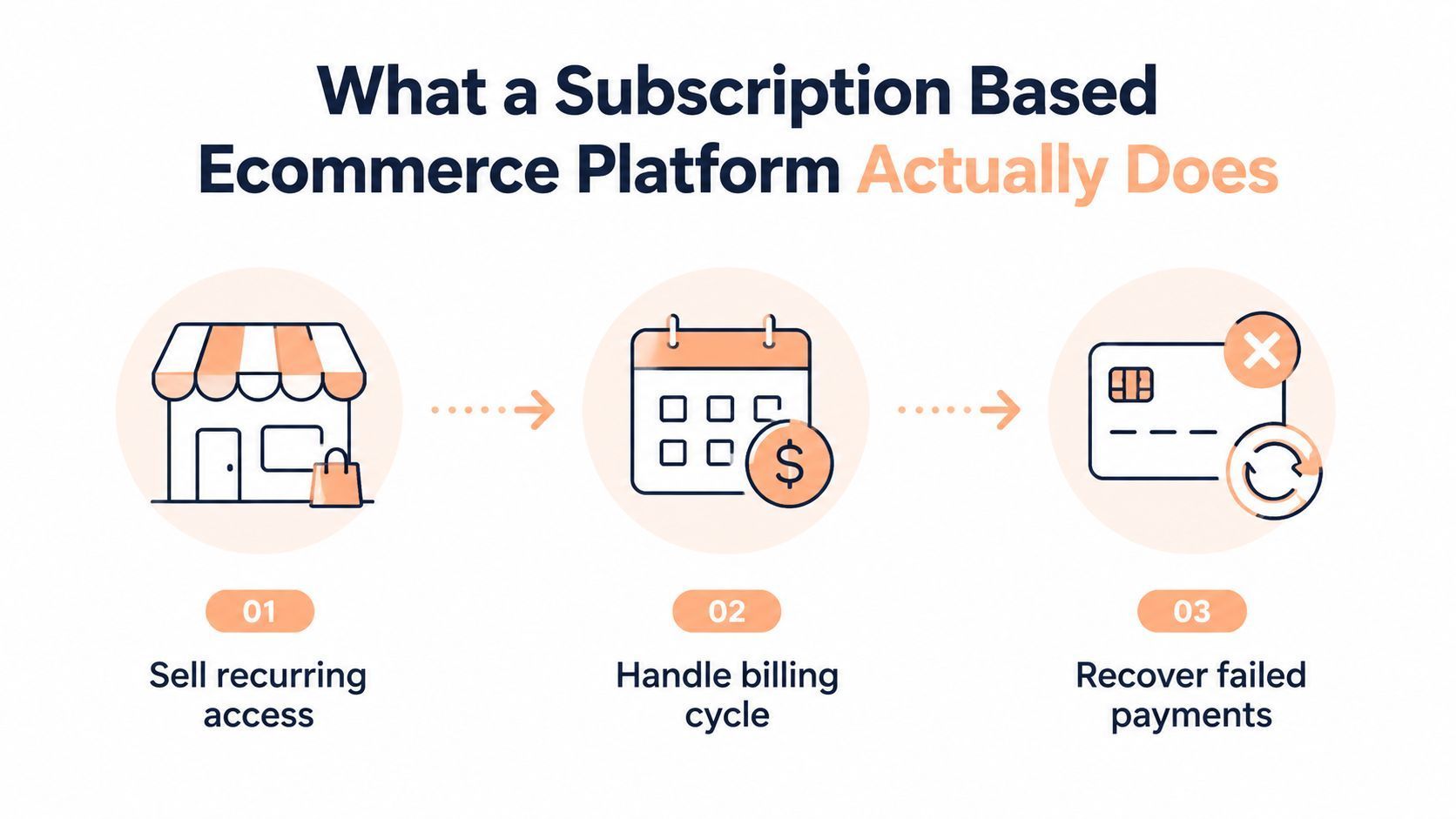
Checkout, charges, records, and invoices working as one subscription lifecycle.
The operating cycle
Each stage needs a clear answer for both the bill and the customer’s access. Check these together:
- Signup and trials: connect the purchase to the intended account, and keep trial access separate from access earned by a successful charge.
- Renewals: identify whether the invoice is awaiting payment, the card needs authentication, or collection has failed.
- Plan changes: check the prorated bill and permissions after an upgrade, downgrade, or seat-count change.
- Usage and credits: verify that metered charges and top-ups match what the customer can consume.
- Failed payments: specify access during retries and which successful-payment event restores paid access.
- Refunds: decide what access remains after money is returned.
- Pause and resume: check when billing and access stop and restart.
- Cancellation: confirm that stopping renewal leaves access intact until the paid period ends, if that is your policy.
Records, data ownership, and migration
Exporting customers and subscriptions is one task. Moving saved payment details to another provider is a separate requirement. Your exit plan also needs to cover record mapping, invoice-history retention, and migration costs.
A sample export covering customers, subscriptions, discount codes, and invoices, plus a written answer on whether saved payment details can transfer, tells you what leaving would actually cost.
The decision criteria that separate platforms
When a customer buys your subscription, direct billing leaves you as the legal seller responsible for transaction taxes. A merchant of record takes those responsibilities under its agreement. Product delivery and support stay yours.
The cheapest launch rate can become the most expensive setup when pricing changes. Compare transferred responsibilities before rates.
Score the risks, not the screenshots
If a vendor cannot accept your product, country, or customer markets, feature scores mean nothing. A low fee cannot offset a payout hold your cash flow cannot absorb.
Score each check separately:
- Tax liability: who carries it?
- Chargebacks: who bears the loss?
- Recovery: who owns unresolved renewals?
- Proration: does the upgrade charge correctly and unlock access?
- Pricing: can your tier run your planned seats, meters, or credits?
- Payouts: check holds, deductions, minimums, transfer costs, and when earnings become available, transfers are processed, and cash arrives.
- Cost: include fees, leftover tools and work, implementation, financing, and seller-borne losses, with uncertain downside listed separately. Request a complete example invoice, not a headline rate.
- Exportability: can you take customers, subscriptions, and invoices with you when you leave?
- Reporting: are voluntary cancellations, failed payments, upgrades, downgrades, refunds, and reactivations reported separately?
- Compliance: review PCI responsibilities, SOC 2 documentation, GDPR handling, access controls, retention policies, and audit logs.
Use 0 for unacceptable or unresolved exposure, 1 for material exposure with weak evidence, 2 for acceptable exposure with documented mitigation, and 3 for acceptable exposure with strong evidence and clear accountability. Unacceptable legal or cash-access risk means rejection regardless of the total.
Write the evidence source beside each score: demos show today’s flow, docs describe expected behavior, and contracts assign responsibility.
Two questions to ask every vendor
“Can you show a failed-renewal recovery report through recovery or closure?”
Look for retries, notices, payment-method updates, and the final outcome, including who handles unresolved payments and access.
“Can you provide a written tax responsibility matrix for our product, business location, and customer regions?”
For each region, it should name who calculates, collects, files, and remits transaction taxes, issues invoices, and validates tax IDs, including exclusions and duties you retain. It should distinguish transaction taxes from taxes on your earnings.
Matching platform strengths to seller profiles
Choose for your next operating stage. Weight the scorecard around the work that stage creates.
Solo indie sellers
Checkout colours get set once. Tax work and invoice requests keep taking time from product work. Prioritize removing those recurring jobs over polishing checkout.
No monthly fee limits fixed costs in a zero-sales month. Built-in affiliates or license keys earn their place when they remove another tool to maintain.
Even with a merchant of record, you still support the product, handle required business registration, and pay applicable income tax on your earnings.
SaaS teams
Existing subscriptions need continuity through a switch. Include their next renewal in your evaluation.
For an illustrative $20-per-seat monthly plan with immediate prorated billing, adding two seats halfway through the month should cost about $20 in total: $10 per new seat. Test that charge and immediate seat access in the sandbox.
AI teams should compare cash timing too. A heavy user on a flat seat price can consume compute beyond what their subscription covers. Prepaid credits bring cash in before consumption, while meters support charging for actual usage.
Agencies and productized studios
If a designer receives 30% of an illustrative $100 template sale, their share is $30. Settle whether a refund takes that $30 back from their share. The split pays the designer, while the invoice identifies the legal seller.
When the client owns the product and you run its billing, separate client accounts keep each client’s sales, invoices, and payouts apart.
Integrations, APIs, and developer experience
Your team should be able to retrieve customers, products, prices, subscriptions, invoices, transactions, refunds, payment methods, and entitlements through documented endpoints. If the platform exposes only hosted checkout sessions and opaque callbacks, your application will struggle to answer basic billing questions or keep access synchronized. Queryable records and events are what customer service, analytics, refunds, and migrations run on.
If the same billing event arrives twice and your app applies it twice, a credit purchase can turn into extra credits you never sold.
Replay a credit top-up event in your proof of concept and check idempotency: processing the same event again should have no additional effect. The customer’s balance should increase once. A duplicated renewal should likewise leave the paid-through date unchanged after the first update.
Your own state-changing requests need the same protection. If a network timeout follows a subscription creation or refund request, your application needs an idempotent retry that will not create a second record or charge.
Delivery itself needs checks beyond replay:
- Signatures: can your server verify that each event came from the platform?
- Stable identifiers: does every event carry an ID you can use to spot duplicates?
- Retried delivery: are failed deliveries retried automatically?
- Inspection: is there a dead-letter queue or comparable tool for events that never arrived?
- Coverage: does every state change create a documented event?
Check the plan and credit balance in your own database against what the billing dashboard shows for that customer. Any mismatch needs resolving before live transactions.
Two rules keep keys out of the wrong hands and environment:
- Keep secret API keys server-side, outside browser code, public repositories, and logs. Anyone who finds one could act as your account.
- Keep test and live credentials separate. A sandbox run should never use keys that can charge a real card or unlock production access.
SDK quality decides how fast documentation becomes working code. Check coverage for the languages your team uses, including Node, Python, and PHP where relevant, along with typed models, useful examples, test environments, and clear error responses.
Retention, recovery, and the new compliance layer
A declined card from someone who wants to stay calls for recovery. A click on cancel calls for a clean exit.
Recovery should be fast and controlled
Recovery runs from failure through scheduled retries and customer action to payment or closure. Set the retry limit in advance, and decide what access remains during retries and after the final failed attempt. Test whether retries adapt to the decline reason and stay early and limited, instead of repeating one rigid schedule for every failure.
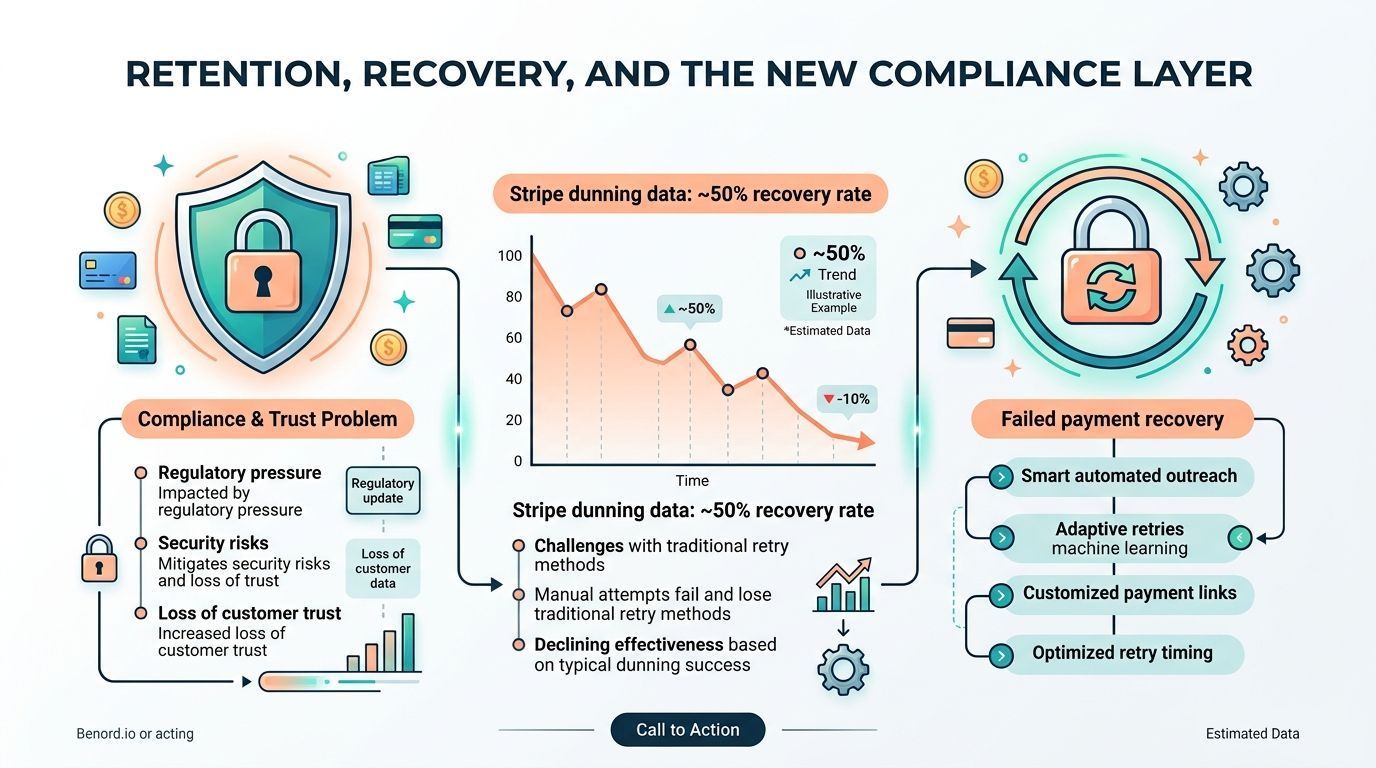
Failed-payment recovery, from retry to final outcome.
The payment message should link directly to payment-method updates: “Your renewal payment failed. Update your payment method in the customer portal.”
Assign one owner to use the recovery report requested from the vendor to review:
- Unresolved renewals that need action.
- Successful recoveries that should leave the queue.
- Subscriptions reaching the retry limit and their final access state.
An unfinished checkout needs a different message from a failed renewal because the purchase was never completed. Keep that follow-up separate and use it only when checkout captured their email.
Cancellation is part of retention
Subscribers should be able to cancel without accepting a pause or working through a retention offer. Obstacles may preserve a charge while costing you their trust.
Confirmation should settle when recurring billing stops and paid access ends: “Your subscription will not renew. You can keep using your paid plan until the current paid period ends.”
A pause offer needs to explain its duration and what happens afterward. For an illustrative pause through next month: “Your subscription is paused until the end of next month. Billing restarts automatically when the pause ends, unless you cancel first.”
Track the two kinds of loss apart with churn analysis for subscription businesses, so win-back campaigns do not chase customers who chose to leave while a recoverable payment problem goes unseen.
Choosing your platform and next steps
If your next stage needs meters, credit wallets, affiliate payouts, or revenue splits, a tax-only service leaves you assembling separate tools around renewals again.
What to do this week
By Friday, aim for a pick backed by a filled responsibility matrix, vendor answers, transaction tests, and an exit estimate. You do not need to finish the billing rebuild to make that decision.
- Shortlist two merchant-of-record candidates and two direct-billing candidates.
- In your responsibility matrix, assign who calculates, collects, files, and remits transaction tax, validates tax IDs, and issues invoices.
- Send each candidate the two vendor questions above, and ask for PCI scope in writing: what your team secures and what the platform handles.
- Midweek, run real transaction tests. If you sell solo, emphasize purchase-to-access. For a SaaS team, emphasize upgrades and plan changes, then compare the results with your current stack and document every custom rule your team would still maintain. For an agency’s own products, emphasize revenue splits.
- By Friday, estimate the cost of leaving each candidate: export work, subscription migration, and integration changes.
Pick the recurring billing platform that can run renewals, tax, and payouts at your next stage.
Review the choice quarterly. Pricing models change, payment methods expand, regulations evolve, and finance teams discover new reporting needs. Each review should check failed renewals, tax handling, plan changes, refunds, and product access for revenue leakage before those issues spread into support work.
Hand off the legal sale and billing to Creem
If you would rather not become the legal seller in every country a card is charged, pick a merchant of record that also runs your billing. We built Creem to be that seller for software and digital products. It accepts the payment, calculates and remits VAT, GST, and sales tax, and issues the invoice.

For a SaaS or AI product selling worldwide, subscriptions, usage meters, prepaid credits, affiliates, and revenue splits run in the same platform, so partner payouts follow the same money path as renewals. Developer SDKs, REST APIs, and webhooks give your team the records and events the integration tests call for, and customer self-service keeps routine billing requests away from support. Checkout runs on your own domain. Uneed (Thomas Sanlis), DaisyUI (Pouya Saadeghi), and Active Builders (Marko Denic) sell on Creem.
You still build, deliver, and support the product. Once the vendor questions from earlier have their answers, try Creem and let it carry the seller's side of every renewal worldwide.