
Ask sellers on Hacker News about Paddle and two views come back. Some say 5% sounds steep next to Stripe's processing rate. Others pay it gladly, because it spares them from dealing with tax rules in every country they sell to.
Both groups are judging the same number, and that number is only part of what leaves your account. Currency conversion sits outside the fee and applies at payout. Payouts run on a rolling schedule with a holding period, and some bank and currency pairs pay about $15 for a SWIFT wire.
If you budget compute, payroll or partner payments on the headline rate, the gap shows up later in your bank balance. You can work out what Paddle keeps at your order size, and when the rest reaches you.
Creem is a merchant of record like Paddle, at 3.9% + 40¢ per successful transaction, with tax, invoices and chargebacks inside that rate. On a $100 sale that leaves you $95.70 against $94.50 on Paddle. If you want the same tax coverage at a lower rate, try Creem.
Paddle's two pricing options
Paddle publishes a rate anyone can take. It also offers custom quotes for high volume, complex billing, or products under $10, and lists high-volume, low-value transactions as a fit for custom plans.
Paddle prefers annual contracts, and two- to three-year deals can bring a further 15–25% off. Weigh that discount against how long you’re willing to commit, not just the transaction rate on the quote.
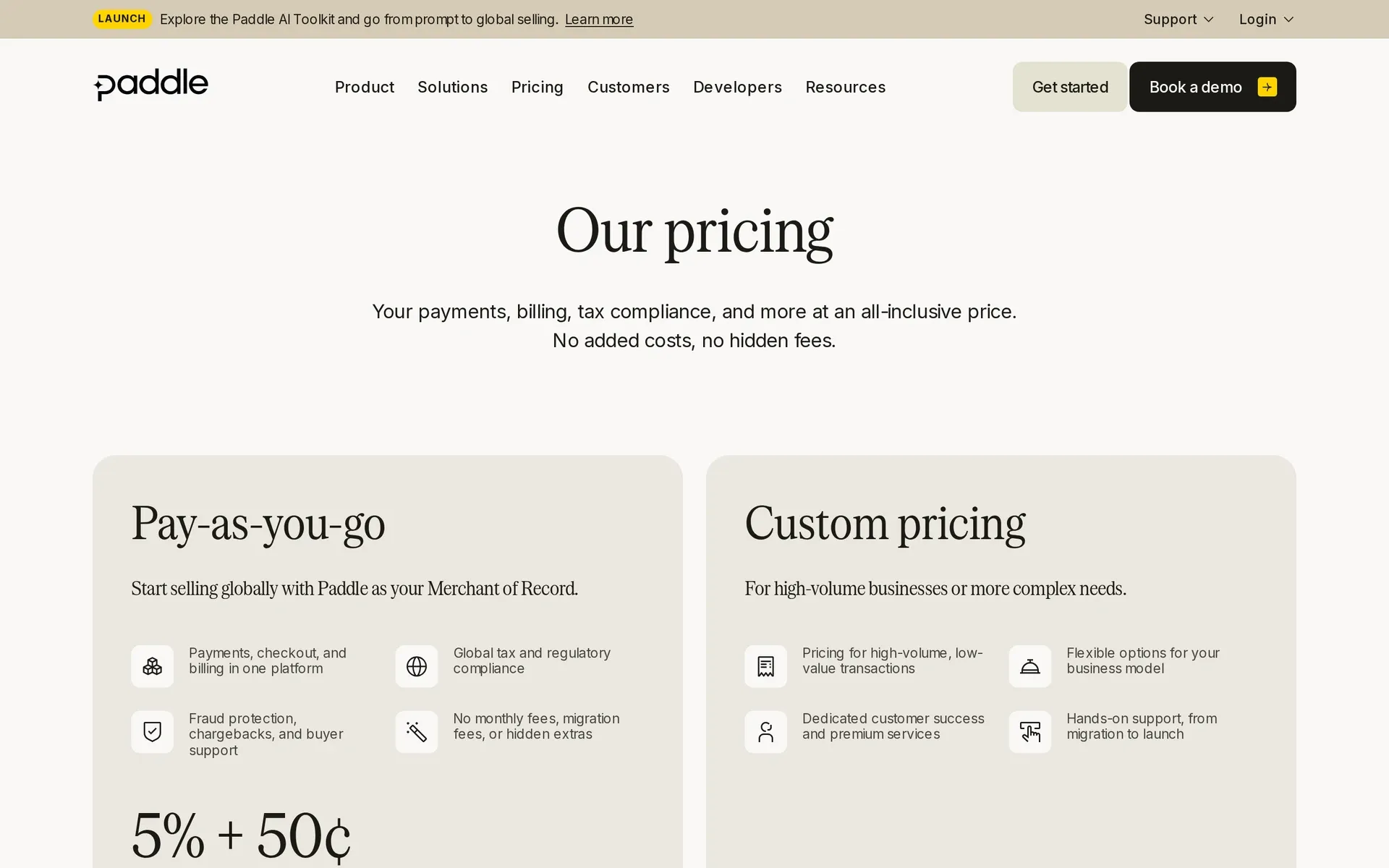
Pay-as-you-go (5% + 50¢ per transaction)
No sales means no cost that month, because there’s no monthly fee. As sales grow, the charge grows with them, but every transaction carries the fixed 50¢ regardless of its price.
How Paddle fees work
Each checkout on the standard pay-as-you-go plan carries both parts of the 5% + 50¢ fee, with no monthly fee on top. You pay that rate for Paddle to be the seller on your buyer’s receipt. Its pricing page lists what is included:
- Transaction tax: VAT, GST or sales tax charged at checkout and filed by Paddle (your income tax stays yours)
- Fraud protection on each payment
- Chargeback handling when a buyer contests a charge
- Buyer questions about payments, subscriptions and cancellations
The same page says additional payment methods carry no extra charge, so local methods at checkout do not need a separate line in your budget.
Currency conversion sits outside the 5% + 50¢ fee. The margin applies at payout when a sale settles in a currency other than your payout currency.
Check the currencies you price in against the currency you get paid in. Whether they match determines whether that margin applies to you at all.
I read 5% + 50¢ as a bundle price. It looks high next to a processor’s rate, but a processor leaves you to handle tax registration, filings and disputes.
What Paddle costs at your order size
Pick the case closest to your average order value, then use the formula below the table to run your own numbers.
Same revenue, different transaction counts
These examples use Paddle’s standard checkout rate on $10,000 a month subject to its percentage fee, excluding other deductions. The 5% is $500 in every case, so only the number of 50¢ charges changes:
| Case | Average order | Payments | Fixed charges | Total fees | Effective rate |
|---|---|---|---|---|---|
| 1 | $10 | 1,000 | $500 | $1,000 | 10% |
| 2 | $50 | 200 | $100 | $600 | 6% |
| 3 | $100 | 100 | $50 | $550 | 5.5% |
Put your monthly revenue and payment count into this formula:
Monthly checkout fees, excluding other deductions = 0.05 × revenue Paddle applies its percentage fee to + $0.50 × transaction count.
Monthly vs annual billing
For a fully paid year with no extra subscription charges, billing once rather than twelve times saves $5.50 per customer each year, assuming the same total revenue subject to Paddle’s percentage fee.
Each small credit top-up gets charged like a monthly renewal, so fewer, larger packs mean fewer 50¢ charges.
An annual discount changes the math. Paddle’s own developer tutorial uses prices of $10 monthly or $100 annually. Twelve monthly payments collect $120, incur $12 in fees and leave $108.
One $100 annual payment incurs $5.50 in fees and leaves $94.50. That leaves you with $13.50 less because the $20 discount is larger than the fee savings.
I would treat these as separate decisions. Billing less often cuts fixed fees, while a discount reduces what you collect.
Paddle pricing details to confirm before you budget
The fee math shows what Paddle keeps from each sale. What reaches your bank account, and when it arrives, depends on separate payout terms.
I would get these terms in writing for your products before using the estimate to budget for compute, payroll or partner payments:
- Renewal charges: Confirm whether each subscription renewal pays the same rate as the first checkout.
- Payout timing: Payouts run on a rolling schedule, typically weekly, with a holding period. Confirm how long that hold lasts on your account.
- Transfer costs: Paddle charges no payout fee, but a SWIFT wire can cost about $15 for some currency and bank combinations. Check whether yours qualifies.
- Refunds: Ask whether refunding a buyer also returns the original transaction fee.
- Disputed payments: Paddle absorbs chargeback fees. Confirm what happens to the disputed sale amount itself.
Creem processes payouts on the 1st and 15th, with a minimum available balance of 50 USD or EUR. New payments may be held for 7 to 12 days for risk review.
Paddle pricing compared with other options
Paddle and Lemon Squeezy publish the same headline merchant of record rate. Stripe starts lower, but your business remains the legal seller.
| Provider | Published transaction rate | Legal seller | Tax collection and remittance |
|---|---|---|---|
| Paddle | 5% + 50¢ | Paddle | Included |
| Stripe | Starting at 2.9% + 30¢ | Your business | Your responsibility (Stripe Tax extra) |
| Lemon Squeezy | 5% + 50¢ | Lemon Squeezy | Included |
| FastSpring | Custom quote, no published standard rate | FastSpring | Included |
| Creem | 3.9% + 40¢ | Creem | Included |
For a $50 sale, Paddle takes $3.00, or 6%, in transaction fees. Stripe’s base processing fee comes to $1.75, or 3.5%, before tax tooling.
That $1.25 difference pays for the tax, fraud and dispute work covered earlier. Stripe Tax adds 0.5% per transaction, taking Stripe’s fee on that sale to $2.00 (4%). You still handle registrations, filings and disputes.
For the same order value, Creem’s transaction fee comes to $1.95 + $0.40 = $2.35.
I would add tax tooling, registration, filing and dispute costs before comparing the processor’s rate. If your team already handles that work, Stripe’s lower processing fee may make sense.
At $100,000 in monthly sales, fees run about $5,000 to $8,500 for Paddle and $3,400 to $4,400 for Stripe, before Stripe’s separate tax compliance costs.
Is Paddle's standard rate right for you?
Paddle's published rate is a fair deal for large or infrequent payments. For small, frequent payments, it is worth comparing alternatives. Your billing pattern decides which route makes sense:
- Higher-priced plans, annual billing or larger orders: the effective rate stays near the 5.5% the table shows at a $100 average order, so taking the published rate is reasonable.
- Low-priced monthly plans or small credit top-ups: payment count drives your cost. Run your count through the formula above for Paddle and for any merchant of record you are weighing.
- High volume or complex billing: if a negotiated rate and a sales-led account matter to you, a Paddle quote is the route to take.
- Physical goods alongside software: Creem's account-review rules prohibit physical goods, so a seller with physical goods has a clear reason to stay on Paddle.
Partner payouts change the total too. If affiliates, contractors or a co-founder take a share of each sale, include that cost on both sides, along with any separate tool you pay for to track and pay them.
On Creem's standard plan, the affiliate platform and revenue splits each add 2% on the transaction before commissions are paid.
I would use the effective rate across your last three months of real payments, not an average order you hope to reach. Export those payments, apply each provider's fee formula to the same set, and compare the effective rates.
Where Creem fits after your Paddle math
Creem is a merchant of record like Paddle, so we are the seller on the receipt. We collect and file the buyer's VAT or sales tax, issue the invoice, and handle compliance and disputes.
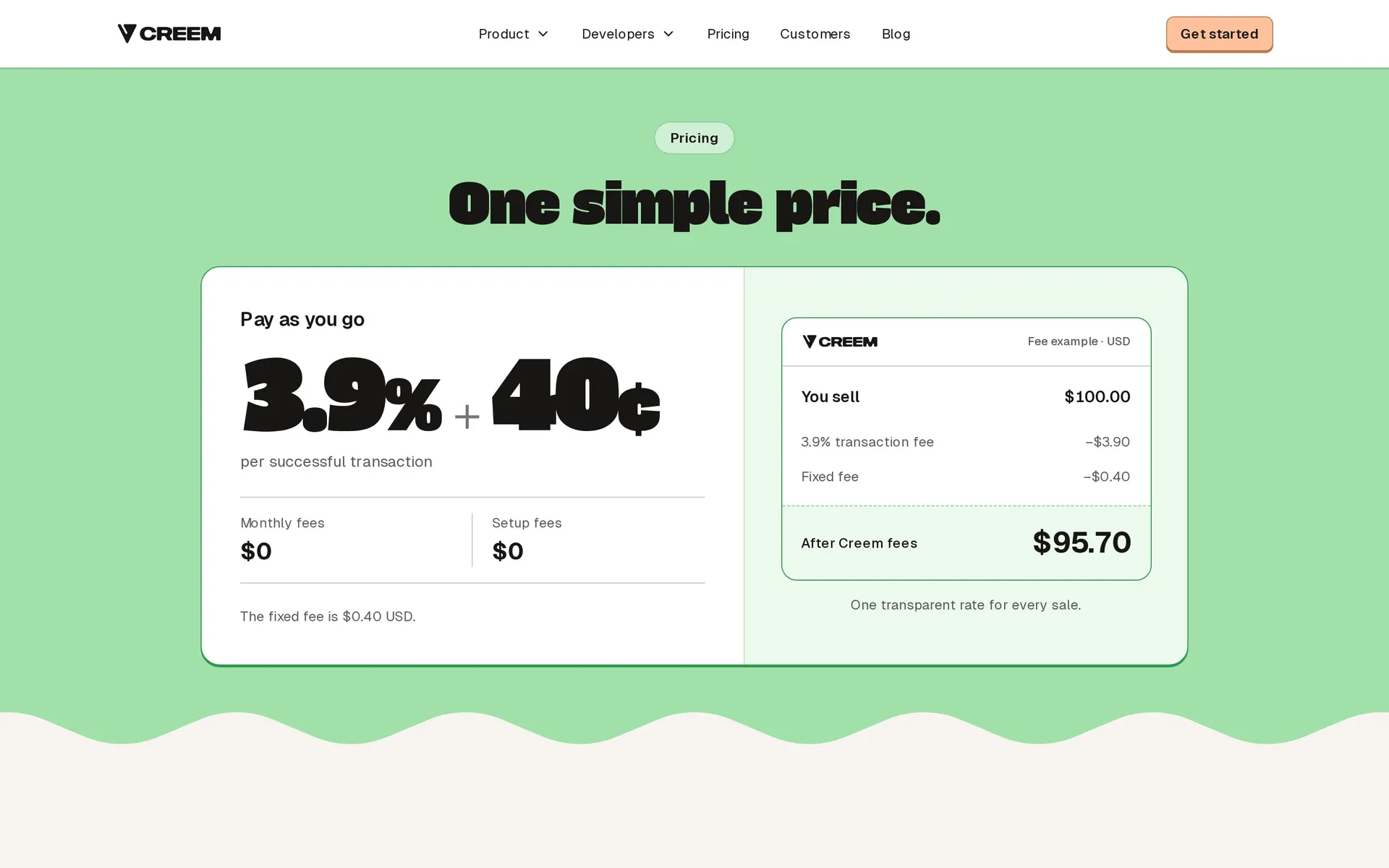
The difference is the rate. Creem charges 3.9% + 40¢ per successful transaction against Paddle's 5% + 50¢, which keeps at least $1,100 more of every $100,000 in sales. There is no monthly fee, setup fee or minimum volume.
New buyers use Creem checkout from day one, and existing subscribers move over at their own renewal, so there is no cutover day. On the code side, Uneed's move to Creem changed 1,500+ lines of payment code in minutes with three AI prompts.
If the math above points away from Paddle, try Creem and keep more of every sale.