
You're setting up payments for your software or digital product, and you'll sell through one provider. Payment processors and merchants of record can both put a checkout in front of a buyer at a published rate, so they look interchangeable. They split the work very differently. The wrong model can leave you owing VAT in a country you've never visited, or paying for a chargeback you assumed someone else would handle.
The real difference is who the legal seller is. A payment processor gives you infrastructure. A merchant of record gives you infrastructure plus someone else taking the legal and compliance responsibility for each sale. On a processor, your business stays the seller, so the tax, the invoice, and the dispute remain yours. Under either model, the product and its support stay with you.
Who the seller is settles who owes the tax and who answers fraud and chargebacks. How much checkout control you keep and what you pay beyond the headline rate depend on the provider and its terms.
What each model actually does
Both models can get a buyer through checkout. The difference is who the buyer purchases from and which jobs still land with you after the charge.
What a payment processor does
A payment processor handles authorization, capture, and settlement: the card is approved, the charge is taken, and the money lands in your account.
For a subscription purchase, that gives you the infrastructure to charge the buyer. The sale is in your business’s name, the invoice is yours to issue, and a dispute comes back to you. You can add tools or hire someone to handle those jobs, but using a processor doesn’t transfer them to another seller.
You’re buying payment infrastructure. How you manage the sale around that payment remains your decision and your responsibility.
What a merchant of record does
A merchant of record, or MoR, sells your product to the customer on your behalf. The buyer purchases from the MoR, which collects the transaction tax, issues the invoice, and handles any payment dispute, then pays you your earnings.
For the same subscription purchase, the MoR is selling access to your software. You still build, supply, and support it. A question about using the product comes to you, while a dispute over the payment sits with the MoR.
That separates responsibility for the sale from responsibility for the product. You keep the product work, while the MoR takes on the seller’s role for the transactions it handles.
Merchant of record vs payment processor at a glance
A lower processing rate can leave you paying for tax tools, filing, and compliance work separately. Compare what the provider takes off your plate before comparing its cut of each sale.
| Responsibility | Payment processor, such as Stripe’s processor setup | Merchant of record |
|---|---|---|
| Legal seller | Your business | The MoR |
| Transaction taxes and invoices | You handle VAT, GST, sales tax, and customer invoices | On sales it handles, the MoR calculates, collects, files, and remits VAT, GST, and sales tax where due and issues invoices |
| Chargebacks and fraud | Screening tools can flag suspicious payments, but chargeback liability stays with you | The MoR handles chargebacks and fraud as the seller |
| Checkout and billing control | You wire the payment flow and billing logic. Marketplace payouts and custom billing rules are yours to shape and maintain | The provider runs checkout, which may carry your branding depending on the provider. How far you can change it varies by provider |
| What the fee buys | Payment processing. Tax tooling, filing, and internal compliance work cost extra | Processing plus legal-seller transaction duties. Optional commerce tools and payout costs can add to the bill |
The tradeoff is real but simple: more structure in exchange for handing off the transaction-tax and dispute work on covered sales.
PCI scope follows your checkout implementation under either model. Outsourcing card collection reduces what you handle, while building your own card form widens what you have to secure. Hosted, embedded, and component-based options carry different customization and maintenance requirements.
Who owes the tax on each sale?
With a processor, you owe VAT, GST, or sales tax where registration thresholds, buyer status, and local rules require it. With an MoR, the MoR owes it on sales it handles. Registration thresholds, the buyer’s business or consumer status, and each jurisdiction’s rules determine where those obligations arise.
For a processor sale, that can mean registering in the country, adding tax at checkout, filing the return, and paying the tax authority. You need someone to handle that work: you, an accountant, or a separate service.
A consumer’s card clearing is where this becomes real. If VAT is due on their subscription, you’ve made a sale with a tax obligation attached. The processor has taken the payment, while the registration, return, and tax payment still need an owner on your side.
Under an MoR arrangement, those steps happen in the MoR’s name because it is the seller on that transaction. A buyer in a new country doesn’t trigger a new transaction-tax registration for you for that covered sale. Your own income or corporate taxes remain your responsibility.
Who carries chargebacks, fraud, and PCI?
With a processor, the dispute and the lost money are yours. Its fraud checks can pass a payment that later turns into a chargeback you pay for. With an MoR, chargebacks and fraud are the MoR's responsibility, because it handles them as the seller.
An MoR's hosted or redirect checkout keeps card collection with the MoR and off your pages, which shrinks your PCI scope. An embedded form sits on your page, so your site needs protection against scripts that could tamper with the payment system. For embedded forms, SAQ A, the PCI self-assessment for eligible outsourced card collection, requires confirmation of that protection, while redirects and fully outsourced payment functions are exempt from this particular requirement.
For embedded checkout, ask whether the form includes script protection when installed as documented, or whether that work is yours. That answer tells you what you still have to secure before taking payments.
How much control do you get over checkout and billing?
An MoR doesn’t lock you into a fixed checkout simply by being an MoR. How much you control comes down to the checkout styles and API the provider offers. A processor’s supported integrations determine how far you can customize the payment flow, with the work of building and maintaining it on your side.
Hosted checkout asks the least of you and gives you the least room to change it. Embedded checkout sits on your page, while component-based checkout lets you shape more of the experience and maintain more of it. Providers don’t necessarily offer all three.
An MoR can run checkout with your branding, though that doesn’t guarantee unrestricted layout or payment-field customization. It is the seller on the transaction. The product, your app’s customer accounts, and the ongoing customer relationship stay with you.
For usage-priced software, your app still counts the API calls or tokens, turns them into billable units, and sends those counts to the billing system. It also decides whether to pause access when a renewal fails. The provider can run the charge without making those product decisions for you.
Ask the provider:
- Can I change the checkout layout and the offer it shows?
- Can I bill the exact unit my product measures?
- Does my app get told when a charge fails, so it can act?
What each model really costs you
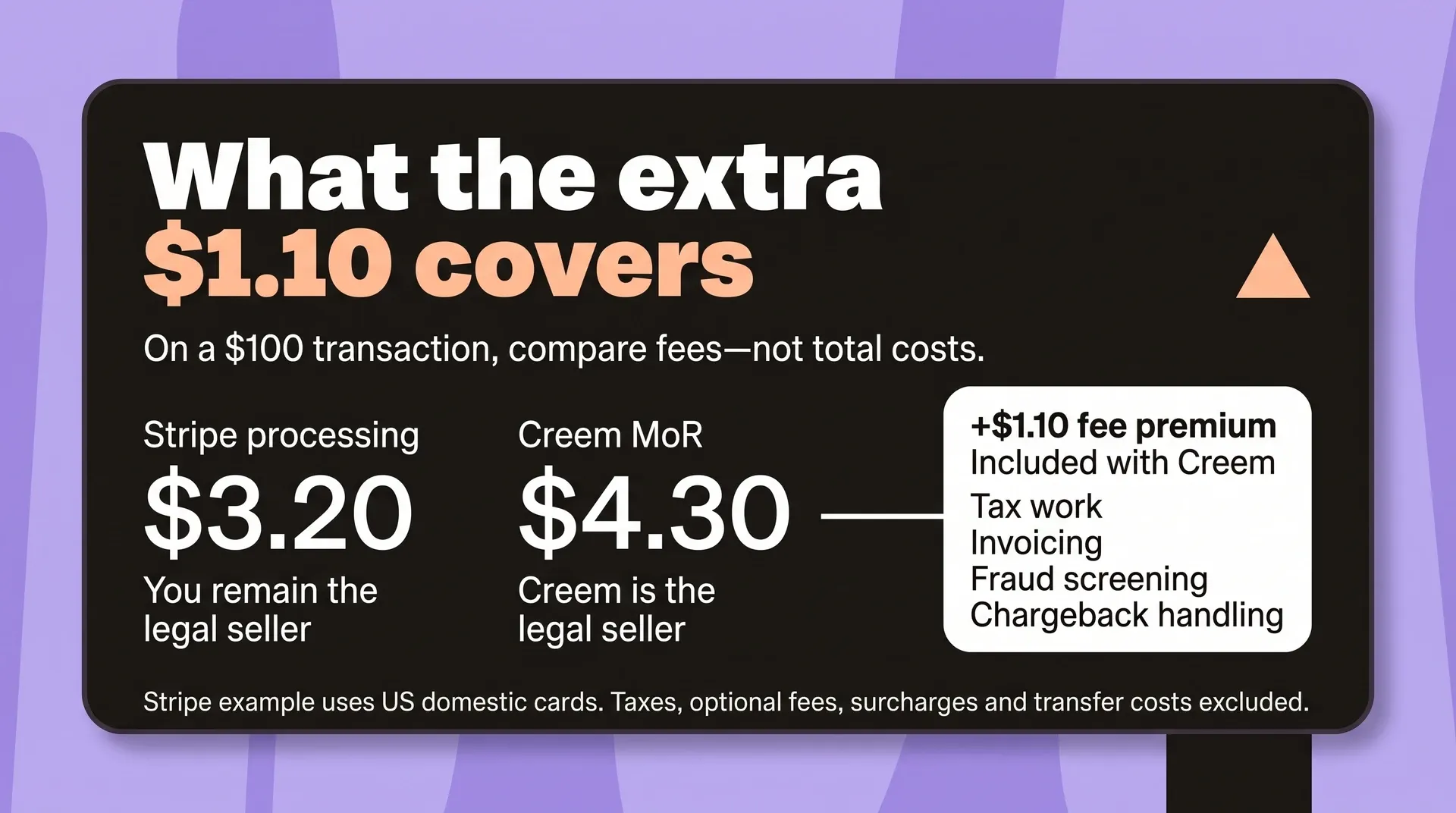
A processor is cheaper for processing alone. Its lower rate leaves tax tooling, filing, and dispute work outside the price. Stripe’s standard US domestic-card rate of 2.9% + 30¢ costs $3.20 on a $100 payment. That covers moving the money.
Price the same month of sales through both providers, using the same product prices, buyer countries, cards, and currencies, then add up the charges that apply:
- Transaction fees, including international-card and currency-conversion surcharges.
- Billing and tax tools, plus paid registration, filing, and compliance services.
- Refund costs, dispute charges, and losses your agreement leaves with you.
- Payout fees.
- Extra cuts on affiliate or revenue-split sales, only where you use those features. Check whether the cut comes from your share or the affiliate’s.
Divide the cash total by pretax product revenue. For an illustrative $100 product with 20% VAT, the customer pays $120. A 5% fee on that payment costs $6, which consumes 6% of your $100 product revenue. Check which amount each rate applies to.
Keep founder hours separate from the cash total. If an MoR replaces an accountant you pay to file transaction-tax returns, removing that bill is a cash saving. If you do the filing yourself, you get those hours back instead.
Put the two monthly cash totals side by side, with the hours you still need to spend next to each. That shows what the lower processing rate actually saves you.
Merchant of record vs payment processor: which one should you choose?
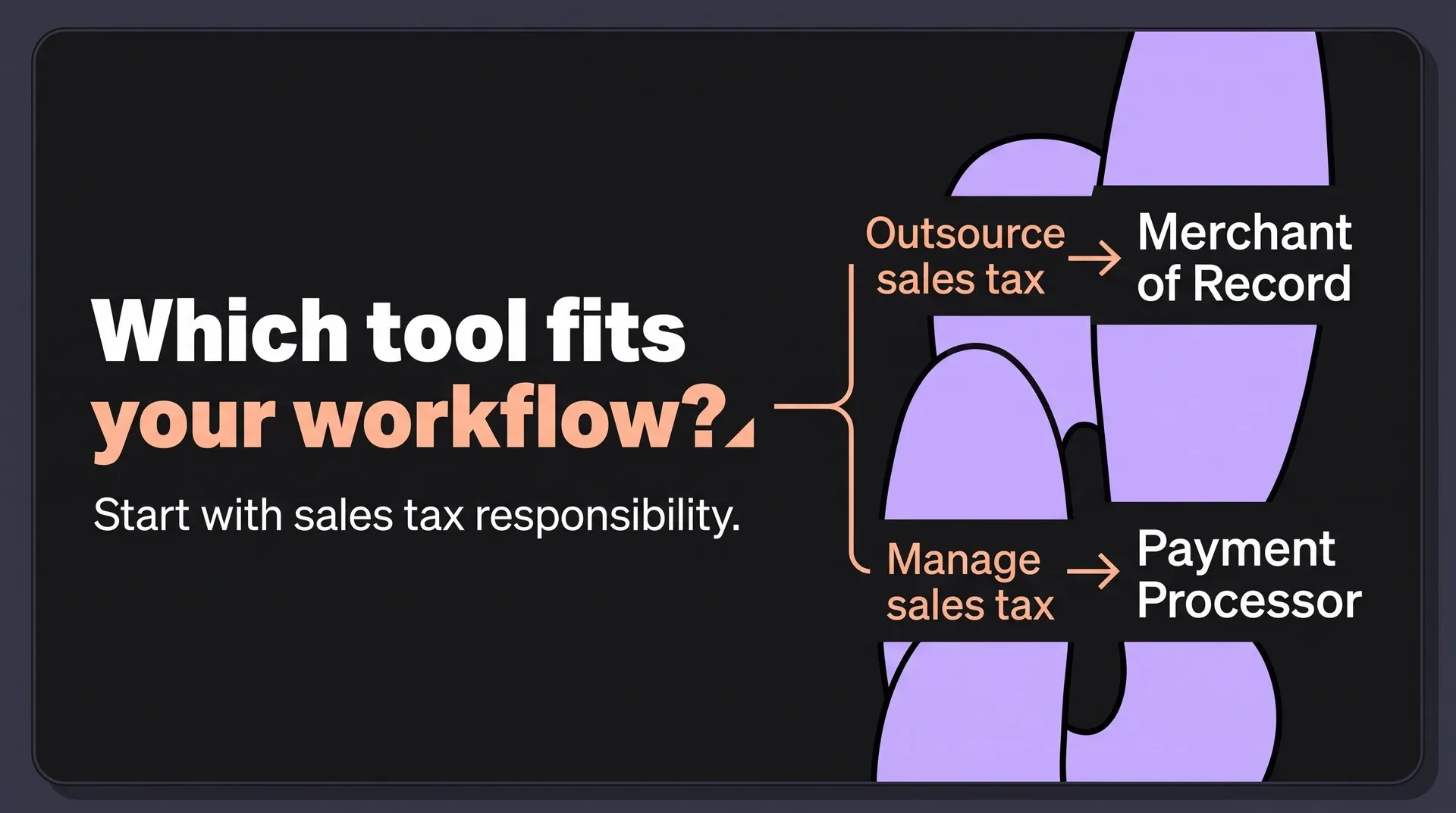
Can someone on your team handle tax registrations, file returns, and fight chargebacks across the markets you sell into? If yes, a processor can work. If no, look at a merchant of record. For most independent software sellers going global, that work costs more than the higher MoR rate.
When a payment processor makes sense
Stripe as a processor is excellent for custom marketplace logic or billing wired deep into your own systems. Those requirements can justify retaining direct payment control. Usage-based pricing alone doesn’t require a processor.
The case is stronger when:
- You already have someone who files tax returns and handles disputes.
- Most of your sales are in one country, narrowing the geographic compliance work.
- You sell mostly to businesses and have finance and legal support. Business buyers can account for international VAT through the reverse charge mechanism.
When a merchant of record makes sense
For a solo developer, a small team, or a bootstrapped founder selling software or digital products to a global audience, an MoR is almost always the right move. Each new market adds rules to assess and potentially registrations and returns to manage, and the lower processor rate doesn’t pay for that work.
If your launch reaches buyers in Germany, Australia, and Canada on the same day, one launch means dealing with three tax authorities’ rules. Obligations don’t necessarily start with the first sale in each market, and working out where they do is itself a job.
For sales handled by an MoR, that transaction-tax tracking sits with the provider. Your team can reach those buyers without taking on the filing work itself. Payout timing and FX sit outside that tax handoff on cross-border SaaS payments.
Does Stripe Tax make Stripe a merchant of record?
Stripe Tax calculates tax and helps you register and file, but your business stays the legal seller. The registrations and returns are in your business’s name, and you remain responsible to the tax authority.
Look at whose name appears as the seller on the buyer’s invoice. With Stripe Tax enabled on a processor setup, it’s still yours.
Stripe Tax is a useful tool, but it isn't a compliance solution. It reduces the calculation work and leaves the registrations, the returns, and the liability in your business's name.
Do you want help getting the tax right while your business remains responsible for filing it? Stripe Tax supports that. If you want someone else to register, file, and answer the tax authority as the seller, you need a merchant of record.
Should you run a processor and an MoR side by side?
For most small teams, one payment path is simpler. A hybrid earns its place when separate groups of sales need different handling. On every sale that stays on the processor, the tax, invoice, and chargeback are still yours.
An MoR handles payment processing as part of its service, so using one doesn’t require opening your own processor account alongside it.
If your domestic business customers need billing tied deeply into your systems, you could keep those sales on a processor and use an MoR for international consumer subscriptions. Moving otherwise identical sales onto the processor to save on the rate brings their tax and disputes back to you. Those costs belong in the comparison.
Keeping both means maintaining logic that sends each buyer to the right checkout, then matching the records from both payment paths in your accounts at month end. A lower rate on part of your revenue can leave you with more work reconciling the whole.
Use the monthly cash totals from the cost comparison, then add the hours spent keeping both paths in sync. For most independent sellers, that complexity isn't worth it unless marketplace logic or deep billing integration truly needs the processor path. Pick one and go.
Where Creem fits
Creem is the legal seller on your sales and the billing and partner-payout layer behind them. Its name goes on the customer invoice, and it files and pays the VAT, GST, and sales tax across 190+ countries on the sales it handles. You still build, deliver, and support the product.
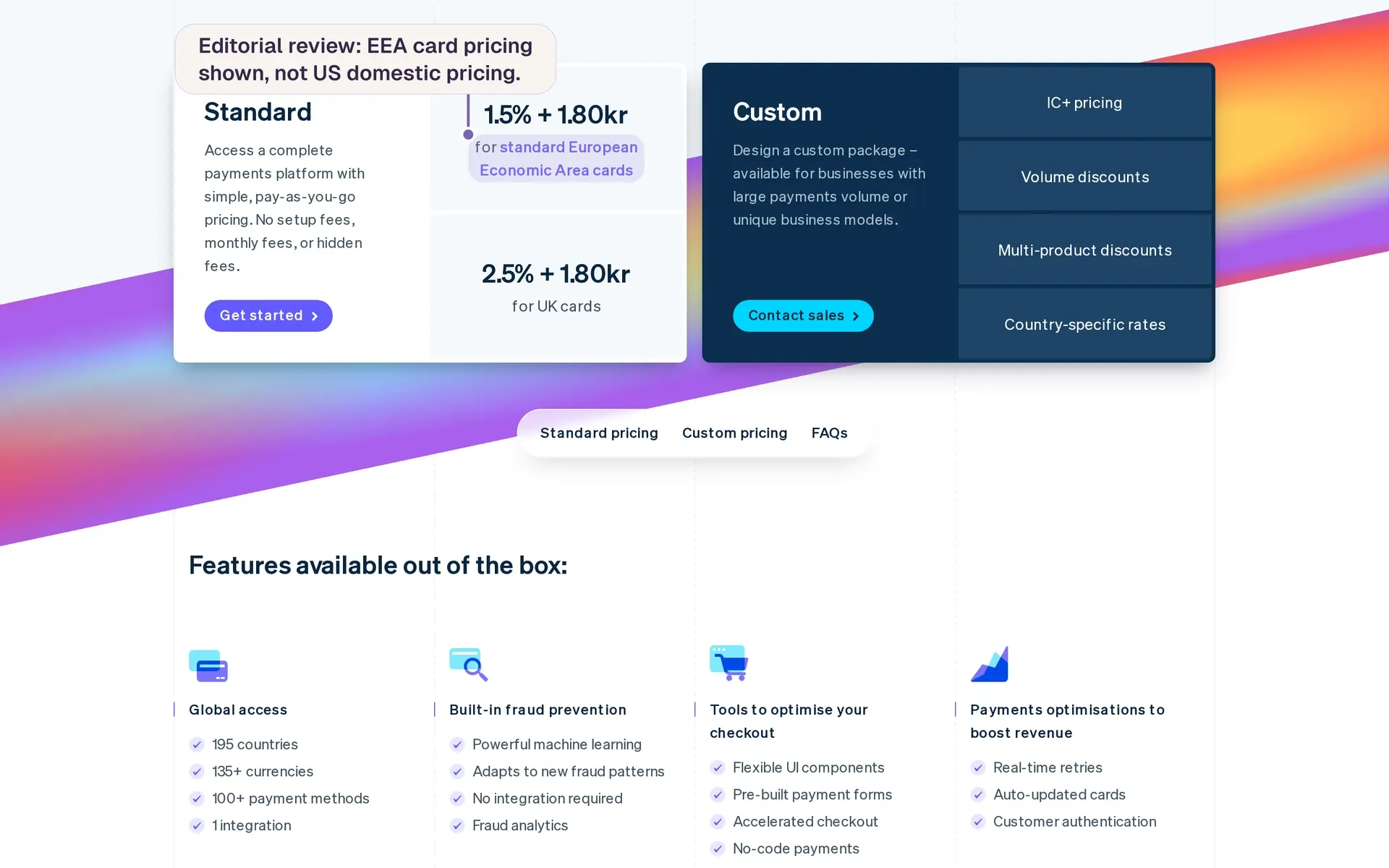
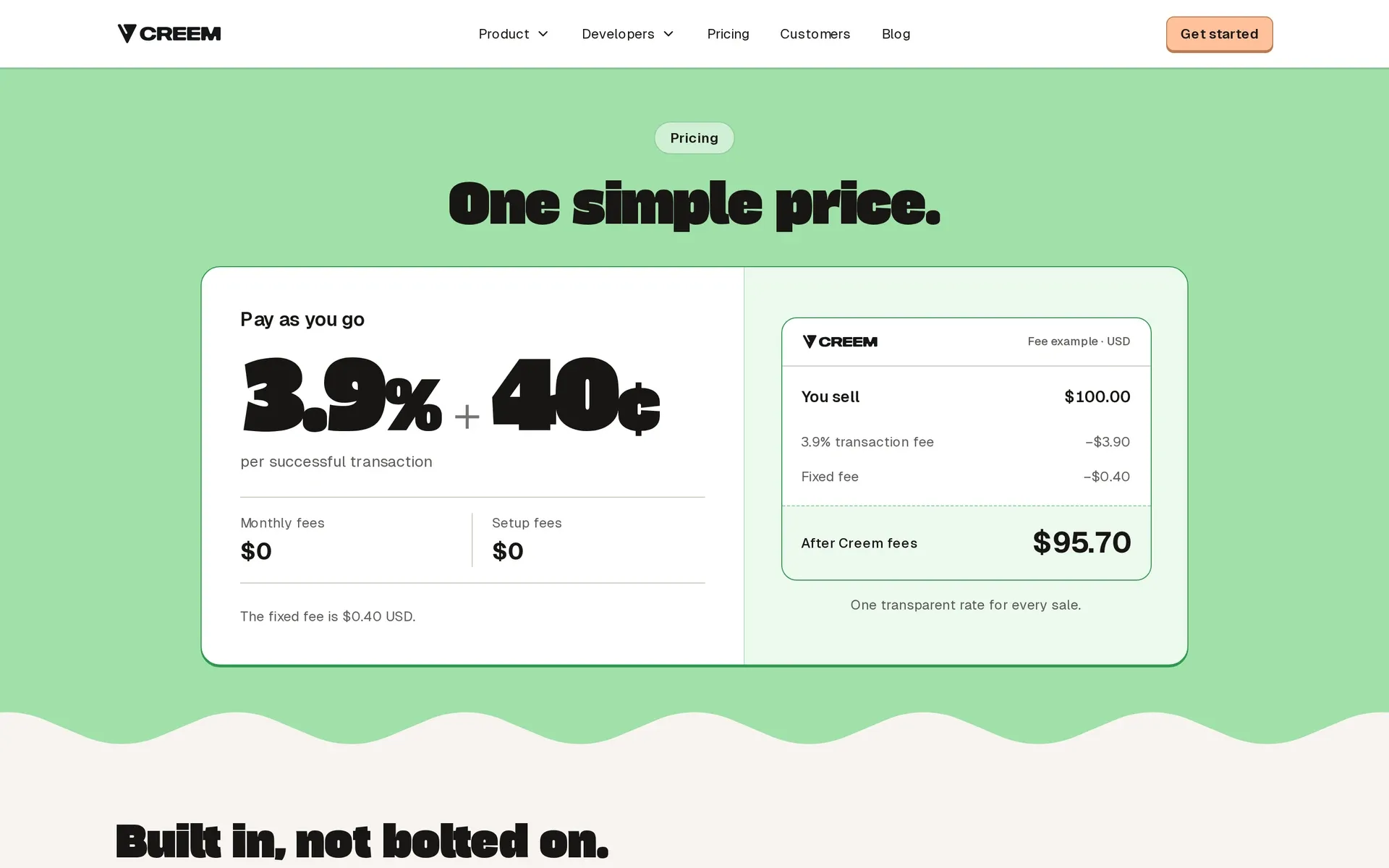
The standard rate is 3.9% + 40¢ per successful transaction. In the pricing page’s $100 walkthrough, Creem keeps $4.30, leaving $95.70 after the transaction fee only, before taxes, optional fees, and transfer costs. That fee also covers the tax work, invoice, fraud screening, and chargeback dispute handling.
We built billing and partner payments alongside that MoR service so you can run them without stitching together separate vendors:
- Creem supports hosted and embedded checkout, plus checkout on your own domain.
- Subscriptions and usage billing support recurring and metered charges. Prepaid credits with auto-refill let customers buy credits before you spend compute.
- Affiliates and automatic revenue splits pay partners through the same platform.
In our DaisyUI case study, profit sharing through revenue splits required 0 extra tools.
What you pay and when you get paid
There’s no monthly fee, setup fee, or minimum sales volume. Beyond the transaction rate, charges depend on what you use:
- Revenue splits add 2% before commissions are calculated.
- The affiliate platform adds a separate 2% before affiliate commission is calculated.
- Abandoned-cart recovery adds 5% on the recovered amount.
- Bank payouts carry a transfer fee, with partner FX costs if your bank currency differs.
- USDC payouts on Polygon cost 2% of payout volume.
Payouts themselves are fast.
Switching doesn’t have to become another long integration project. In our case study with Uneed, its move to Creem changed 1,500+ lines of payment code using 3 AI prompts, with 0 integration errors and migration measured in minutes.
There's no enterprise sales cycle either. You sign up, connect your product, and you're selling globally the same day, so you can get started free and move your checkout when it suits you.
Ready to let Creem be the legal seller?
Who the legal seller is decides who owns the tax, the invoice, and the chargeback on each sale. On a processor, that stays your business in every country a card clears, however good the payment infrastructure underneath is.
For a solo developer, a small team, or a bootstrapped founder selling software or digital products worldwide, that tax and dispute work is the bottleneck. We built Creem to take the legal seller's role on those sales, with subscriptions, credits, and partner payouts running through the same checkout. Uneed made that move in minutes with 3 AI prompts.
If you want the tax in each market remitted for you, get started free on Creem. Only pay when you earn.
FAQs
Is a merchant of record the same as a seller of record?
Both terms name the business the buyer is legally buying from. Check whose name appears as the seller on the invoice.
Does a merchant of record replace my business?
You keep your company, your product, your customer accounts, and the support inbox. The MoR takes the seller’s role on each payment it handles, including the tax, invoice, and dispute on that sale.
How should I compare merchants of record?
Price the same month of sales on each merchant of record you consider, check payout schedules and holds, ask how support handles a missing payout, and check whether affiliates and revenue splits are built in or charged on top.