

If you coach, teach or consult, you can turn the method you repeat with every client into an AI agent and sell access to it by subscription. Buyers don't get an ebook, a course or a PDF that sits unread in their Downloads folder. They get your method applied to their own draft, brief or numbers, at whatever hour they open it.
Creators who sell agents well are building the recurring revenue that courses and one-time downloads never delivered. It still isn't passive income: every conversation costs model usage, and support stays with you after the sale.
Selling an agent comes down to three jobs: winning the sale, collecting the money from buyers in many countries, and delivering what you promised. The 11 steps below cover all three, from picking your buyer to earning the first renewal.
What selling AI agents involves
A course gives buyers your method. An agent applies it to the work they bring. You’re selling software that helps them complete a specific task, with clear limits on what it can do and when they need to step in.
Reviewing a proposal draft and emailing it to the buyer’s client are different jobs. The second gives the agent control over an action that may need human approval. Decide where that control stops:
- Which task the agent handles and where it stops.
- Which actions it can take without approval.
- When the buyer must review its work or take over.
The costs also continue after the sale. A download can need updates and support, but an interactive agent adds model usage costs as buyers use it. More conversations mean more model usage and a higher running cost.
Getting checkout working does not finish the product. You remain responsible for building, delivering and supporting the agent after buyers pay.
1. Confirm your buyer and sales model
Start with a problem people already bring to you in your teaching, content or client work. Look for one that keeps returning and that buyers already spend time or money solving.
Carson Mitchell, an Instagram growth coach, started from that kind of problem. He kept answering the same questions on coaching calls, so he turned his Instagram growth framework into a paid AI agent that handles the repetitive guidance. His subscribers get personalized advice on demand, and he earns recurring revenue without selling more hours. A CommuniPass case study reports that his revenue grew from $8,000 to $39,000 a month in 90 days. We have not verified those figures. The useful part is where he started: the questions clients asked again and again.
Enthusiasm about AI tells you little about willingness to pay. Ask a potential buyer to describe the last time the problem happened, how they handled it and what that cost them. A recent example gives you something concrete to build an offer around.
For a proposal-review agent, the buyer’s situation points to what you sell:
- Subscription access: A sales lead reviews proposals every week and needs guidance throughout the month.
- Prepaid credits: A founder reviews a proposal now and then, so a usage balance suits the gaps between requests.
- Per-task output: The buyer wants a revised proposal handed back and pays for that completed result.
- Template: Someone wants your proposal-review checklist to apply themselves, making the reusable method a separate product from the agent.
For business customers, the person reviewing proposals may not control the budget. Find out who can authorize the purchase. When the agent needs to read company documents or connect to their tools, ask separately who approves that access, because the budget holder may not.
Write one offer sentence naming the buyer, recurring problem and unit being sold: “Monthly agent access for small agency owners who need their sales proposals reviewed before sending.”
2. Package a bounded agent offer
Your first offer should answer a question you already handle often enough to recognize a good answer. Trying to cover your entire expertise makes it harder to tell whether the agent is doing useful work. Pick the question, then define what goes in and what comes back.
If your agent reviews sales proposals before they go to a client, that could mean:
- Buyer inputs: The proposal draft, the client’s brief and any constraints the revision must respect.
- Reference material: Your review checklist and examples of proposals you consider strong.
- Buyer output: A revised draft with explanations for the suggested changes.
Your checklist also hides the clarifying questions and if-then calls you make without thinking. Write down what you usually ask before giving advice and what you recommend for each answer, so the agent can hold the same dialogue. When the client brief is missing, for example, the proposal agent asks for it, then recommends revisions based on what the buyer says.
Before charging, write your own answers for these test cases, then compare the agent’s work against them:
- A routine draft: Check how it handles a straightforward proposal.
- A draft without a client brief: It should ask for missing context or hand the decision back when that context changes the advice.
- A request to write the contract instead: Check that it stays within proposal review.
- A draft promising a discount: Check that it leaves approval to the buyer.
For each test, check whether it gave the response you expected, whether that response is as good as yours and whether it added anything it shouldn’t. The right response may be a revised draft, a request for context, a refusal or a request for human approval. A returned proposal may count as a completed task while still containing weak advice. A polished revision may introduce a promise the buyer never authorized.
The agent saying “done” is not proof of completion. If it can change a file or send a message, check what actually changed or arrived and whether required approval happened first.
Rerun the full test set after every change to the prompt or checklist, and charge only once it passes.
3. Establish your payment architecture
A non-business EU buyer’s card clears through your processor. The payment succeeded, but collecting and remitting the applicable VAT is still your job. Who is the legal seller determines who carries that responsibility.
| Payment processor | Merchant of record |
|---|---|
| You remain the legal seller. | The merchant of record becomes the legal seller. |
| You collect and remit applicable transaction taxes. | It collects and remits transaction taxes for covered sales and jurisdictions. |
| You issue the buyer’s invoice. | It issues the buyer’s invoice. |
| You handle payment disputes. | It handles payment disputes. |
A tax calculation tool works out the tax without transferring legal-seller responsibility.
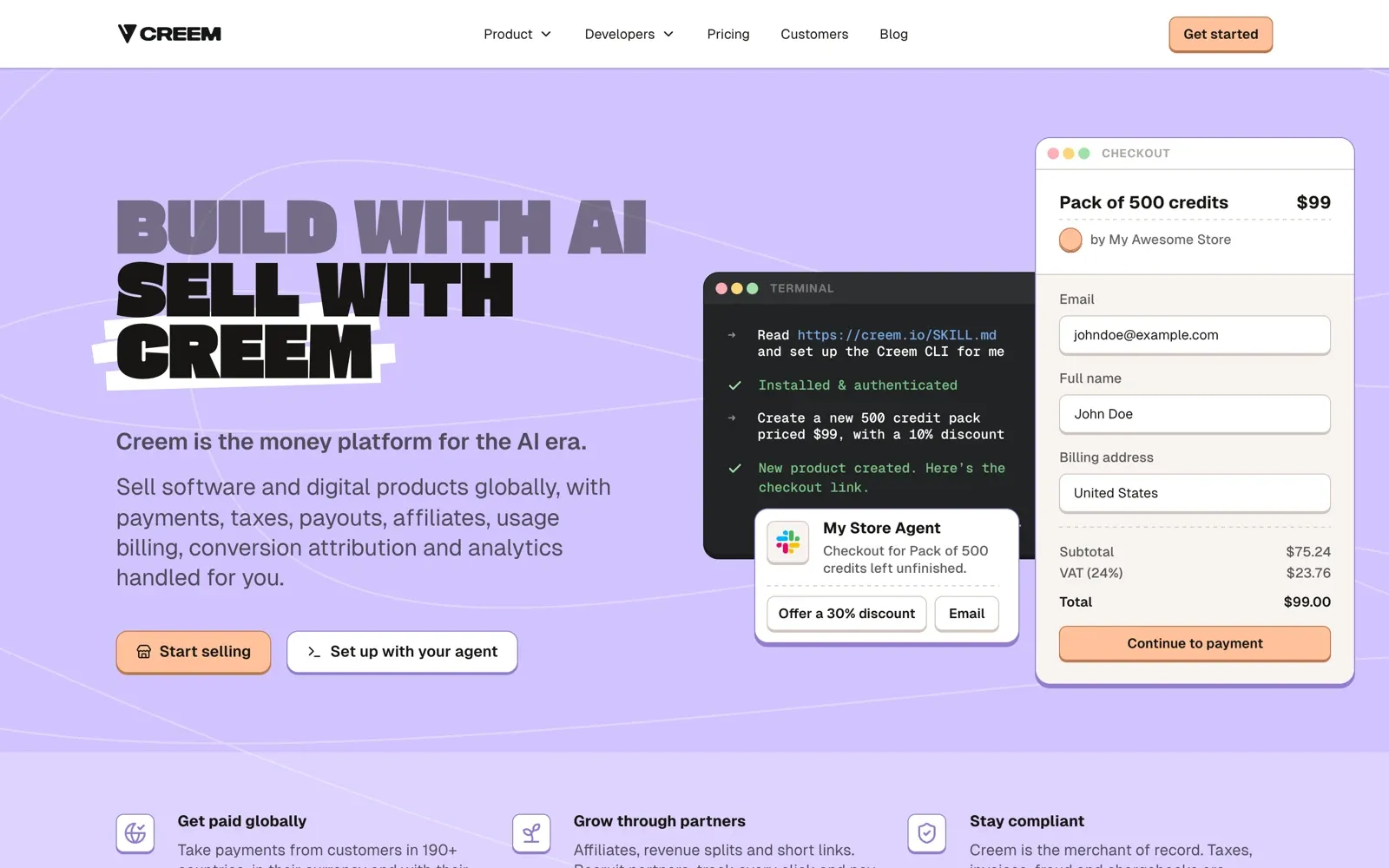
Creem takes the merchant-of-record role for software and digital-product sales. The merchant of record fights the chargeback, while a buyer unhappy with a proposal review is still your support ticket. Choose the seller arrangement before the first international sale, because responsibility for tax on that sale already belongs to whoever is the seller.
Next, match billing to when you incur model costs:
- Monthly review access paid upfront brings cash in for the period before reviews run.
- A per-review meter billed after usage means a failed charge leaves you paying for compute already consumed.
- A prepaid pack of reviews brings cash in before any review runs, then burns down as the buyer uses it.
A subscription can also include a review allowance, with overage charges for heavier use. Meters and credit wallets in Creem track consumption, but your agent must check the buyer’s remaining allowance or credit balance before starting a review. At zero, stop the review or request a top-up unless the buyer has agreed to overage billing.
4. Price the offer and usage
The time or money buyers already spend on the problem gives you a reason for the price. Running costs tell you whether it works for you. Test both typical and heavy usage before promising unlimited access.
From what we see, most agents built from an expert's method land between $47 and $197 a month. A price set too low draws buyers who never commit, and one set too high puts the agent up against your own one-to-one coaching.
In this illustration, payment fees are a round 5% of revenue, and the model and support figures are illustrative too:
| Worksheet field | Typical buyer | Heavy user |
|---|---|---|
| Revenue excluding sales tax | $100 | $100 |
| Payment fees | $5 | $5 |
| Model usage cost | $10 | $60 |
| Support hours | 0.5 | 1 |
| Hourly support value | $40 | $40 |
| Support cost | $20 | $40 |
| Contribution margin | $65 | −$5 |
The typical buyer leaves $100 − $5 − $10 − $20 = $65. The heavy user loses you $5. Hosting, tools and the hours spent building the agent still come out of what remains.
Now apply overages. In this illustration, the plan includes 20 proposal reviews. The heavy buyer uses 25 extra reviews costing $2 each, accounting for the additional $50 in model costs already shown.
Billing those extras at $4 each adds $100. Collected in the same monthly transaction, total revenue becomes $200 and the 5% fee becomes $10. With model and support costs unchanged, the heavy buyer now leaves $90: $200 − $10 − $60 − $40.
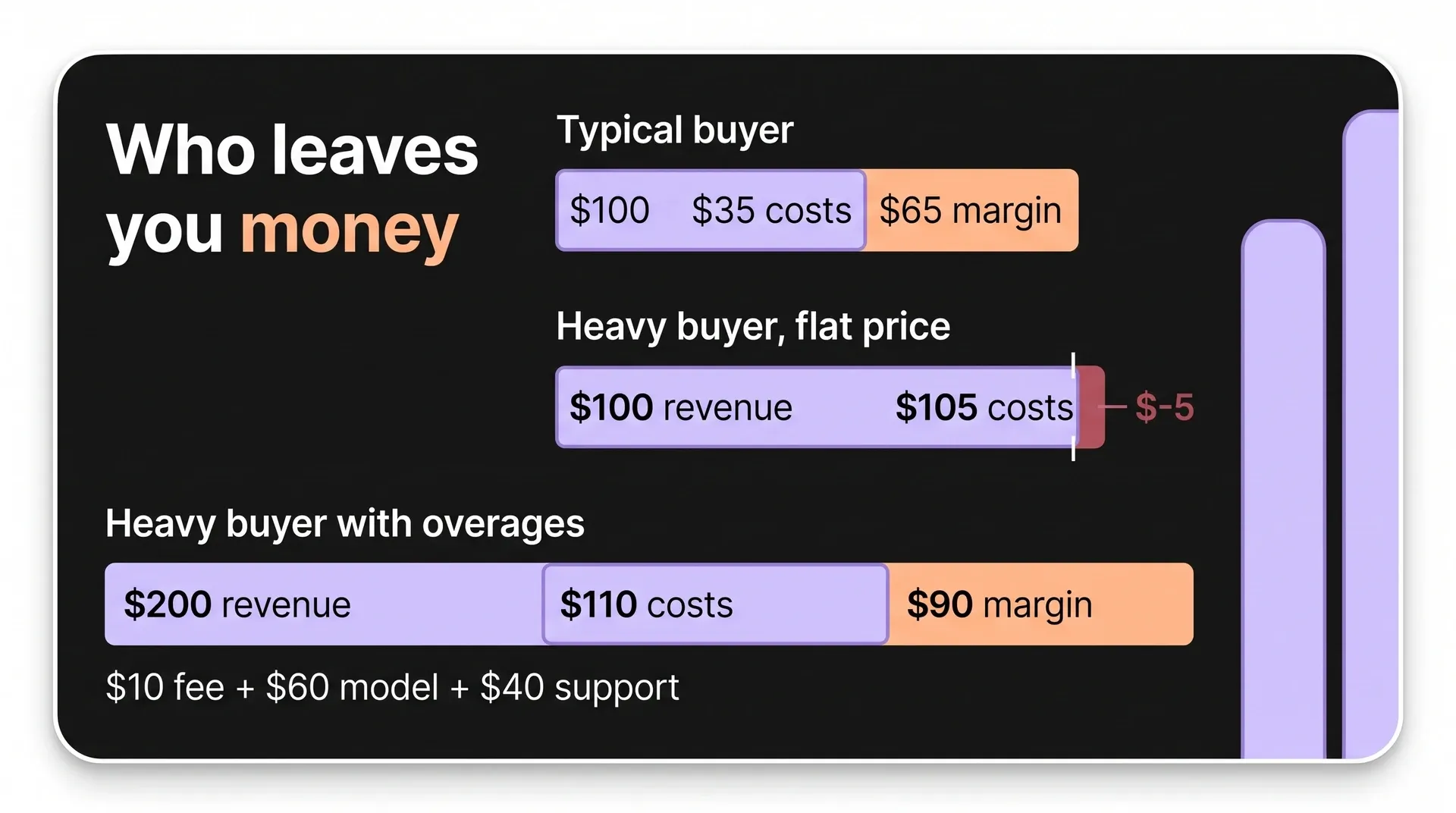
A heavy column built on guesses hides exactly the buyer who loses you money, so fill it with your heaviest test buyer's measured model spend and the support minutes you logged during testing.
5. Choose channels and find buyers
Your newsletter replies or client conversations may already contain requests for the guidance your agent provides. Those people are a useful first audience because they know your method and have brought you the problem.
The same monthly proposal-review access can be sold through a checkout link in a newsletter reply or through a marketplace listing. The product stays the same. What changes is how buyers find it and whether you can keep the relationship afterwards.
Your own checkout gives existing contacts a direct route to buy and keeps renewal conversations with you. You also do the work of bringing buyers to the page. A marketplace adds a discovery channel, but a listing alone does not show that anyone will pay.
Before choosing a marketplace, check the details against your offer:
- Find out whether small agency owners browse there for proposal help.
- Check what you must submit to get the agent listed.
- Calculate the marketplace’s cut on each sale using the margin worksheet.
- Ask whether you receive the buyer’s email and can sell renewals directly.
The description should make the task recognizable. “AI-powered business assistant” gives buyers little to judge. “Review sales proposals for small agency owners and return a revised draft before they send it” names the buyer, task and intended outcome.
Send that specific offer with a checkout link to people who asked for proposal help, count how many pay, and use that result to decide whether to add a second channel.
6. Show it on real work, then run a short paid pilot
A buyer watches the agent review a sample proposal. The answer reads well, but when you ask whether they could send it, they point out that it misses their client’s brief. Their current review process gives you a baseline for judging whether the agent helps.
Invite the person who signs off to the demo. For an existing client or audience member, reply to their request for proposal help and ask for the draft they are about to submit, along with the client’s brief.
Run the agent live, then put its revised draft beside the original. Have the buyer and approver compare it with their usual review process:
- Answer quality: Are the revisions accurate, useful and consistent with the client’s brief?
- Review effort: What must the buyer check, correct or rewrite before using the result?
- Completion time: Include human review, because a fast draft saves little time if checking it takes as long as rewriting it.
Record the buyer’s corrections and whether they would use the result. Turn those corrections into the pilot’s pass criteria, such as revised drafts that need only the buyer’s final sign-off edits before sending.
A paid pilot gives the buyer time to evaluate the agent and gives you a known end date and amount of work. The buyer pays to test a capability you can already demonstrate. If their evaluation depends on a feature you still need to build, agree that development work separately.
For individual buyers, founding-member access can mean one price for early access lasting a set number of weeks, with a set number of runs or conversations included. Make clear what they would pay to continue afterwards.
A business pilot needs an agreed measure of success. For an agent that reviews a business’s sales proposals before they go out, that could mean reducing review time while producing drafts the approver accepts. The approver judges the finished draft itself, rather than relying on the agent’s message that the review is done.
7. Establish trust and contractual boundaries
The limits you tested need to appear in the terms buyers accept. Otherwise, a buyer may treat a suggested revision as an approved decision or assume their documents stay inside your app.
For the proposal-review agent, a scope statement could read: “The agent reviews drafts against your brief and suggests revisions. You approve pricing, commitments and the final draft. Missing or conflicting instructions require your review.”
Buyer-facing terms also need concrete commitments. These examples are illustrative and must match your actual practices:
- Data: “Drafts and briefs go to our model provider for review only. We retain copies for support, then delete them. They are never used for training.”
- Support: “We reply within one business day” commits to a response. “Issues fixed within one business day” also promises resolution, which you may not control.
- Refunds: You define which proposal reviews qualify, while remaining responsible for delivery. The merchant of record processes refunds on transactions it sold.
Name the model provider and any external tools receiving documents alongside the data statement. If a provider uses drafts for training or a logging tool retains copies beyond your stated deletion point, that promise is false. Confirm each tool’s uses and retention before the buyer signs.
8. Collect payment through checkout
Checkout should match the offer the buyer agreed to. Someone paying for a fixed pilot should not discover that they have started a renewing subscription. The purchase summary needs to say what the payment buys:
- Recurring access: Name the agent, included usage and renewal interval.
- Credit pack: Show the credits being purchased and what they can be used for.
- Fixed deliverable: Identify the output the buyer will receive, such as one reviewed sales proposal with suggested revisions.
An international buyer also needs to know which currency their card will be charged in. A dollar symbol alone leaves that unclear. Show the charge currency, offer price, applicable tax and total payable before they confirm payment.
For a business purchase, the buyer enters their company name, billing address and applicable VAT number, which checkout checks for validity. The merchant of record issues the invoice after purchase with those billing details, so you do not have to produce it yourself.
Creem offers hosted checkout on your own domain for buyers following a link from your pilot email, and embedded checkout for buyers paying inside your site or app. Choose the flow that matches where your buyer is accepting the offer.
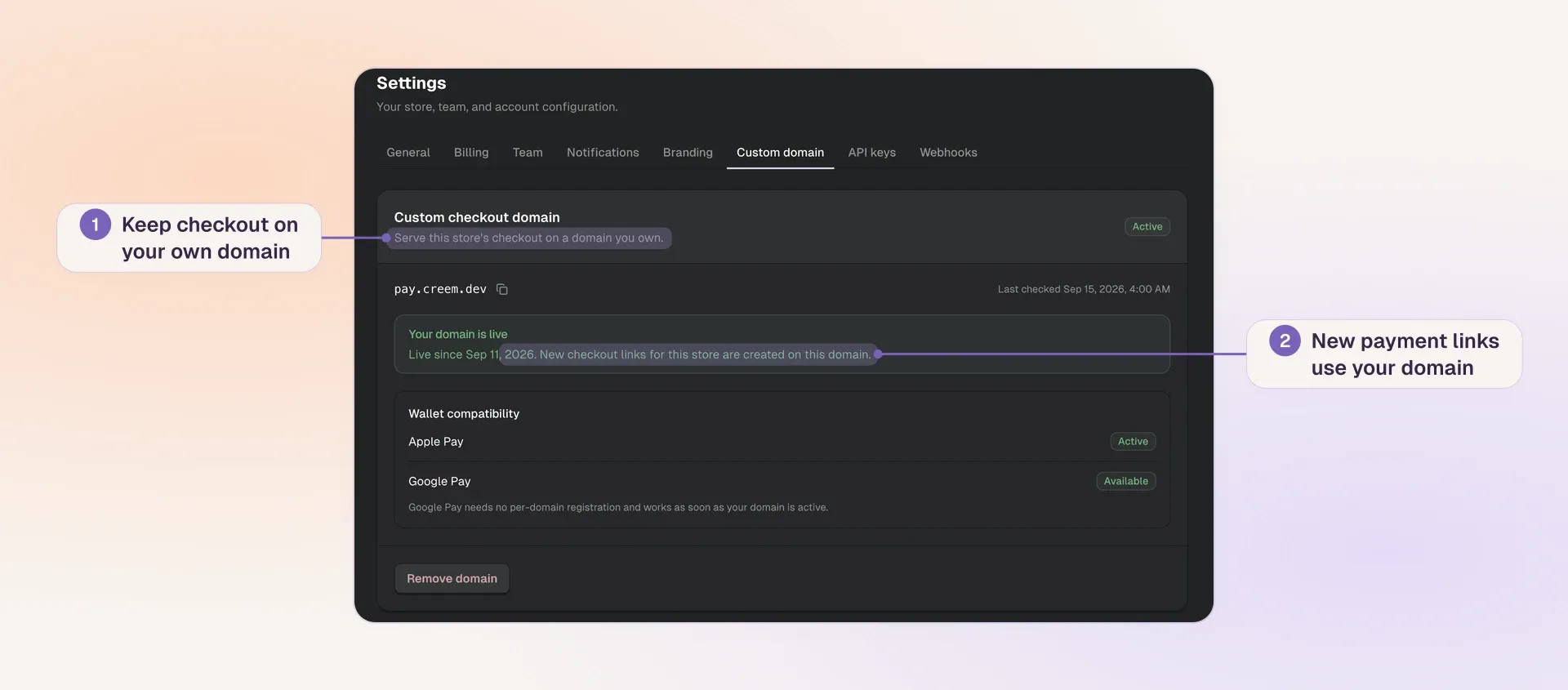
Walk through that flow as a buyer before sharing it. Check that the offer, billing interval and final charge are clear without needing to return to your sales conversation.
9. Deliver the agent and handoff
Your server receives payment and subscription events, matches them to the buyer’s account and activates or extends the access they bought. You build that logic in your app so a confirmed purchase leads to a working agent.
A buyer who cancels keeps using the agent until the access end date you agreed with them. A failed renewal follows the recovery policy you gave them, including any time allowed to update their payment method before access pauses. Test both paths so cancellation does not lock someone out of paid access.
The buyer also needs enough guidance to complete their first task. Send a handoff containing:
- Access: The link or key that opens the agent.
- First-use guidance: The documents to provide, steps to start a review and location of the revised draft.
- Human support: The contact route for access problems or results that need your attention.
For an agent that reviews sales proposals before they go out, walk through the first review from the buyer’s account. Upload the draft and brief, run the review and check that the revised proposal appears where the buyer expects to find it.
10. Share partner revenue and reconcile payouts
Affiliates and co-creators earn for different reasons:
- An affiliate earns commission on purchases attributed to their referrals, so their referral link needs to stay connected to checkout.
- A co-creator earns the share defined in your collaboration agreement, regardless of who referred the buyer.
Agree each recipient’s percentage, the amount it applies to and how refunds affect it. In an illustrative $100 sale, 10% of the price pays the partner $10. Applying 10% after tax and fees pays less. If that sale is refunded, agree whether the partner’s $10 is taken back, deducted from future earnings or kept at your expense.
You can pay partners without adding a separate profit-sharing tool through Creem’s revenue splits and affiliate platform. DaisyUI runs its profit sharing on Creem without any extra tools.
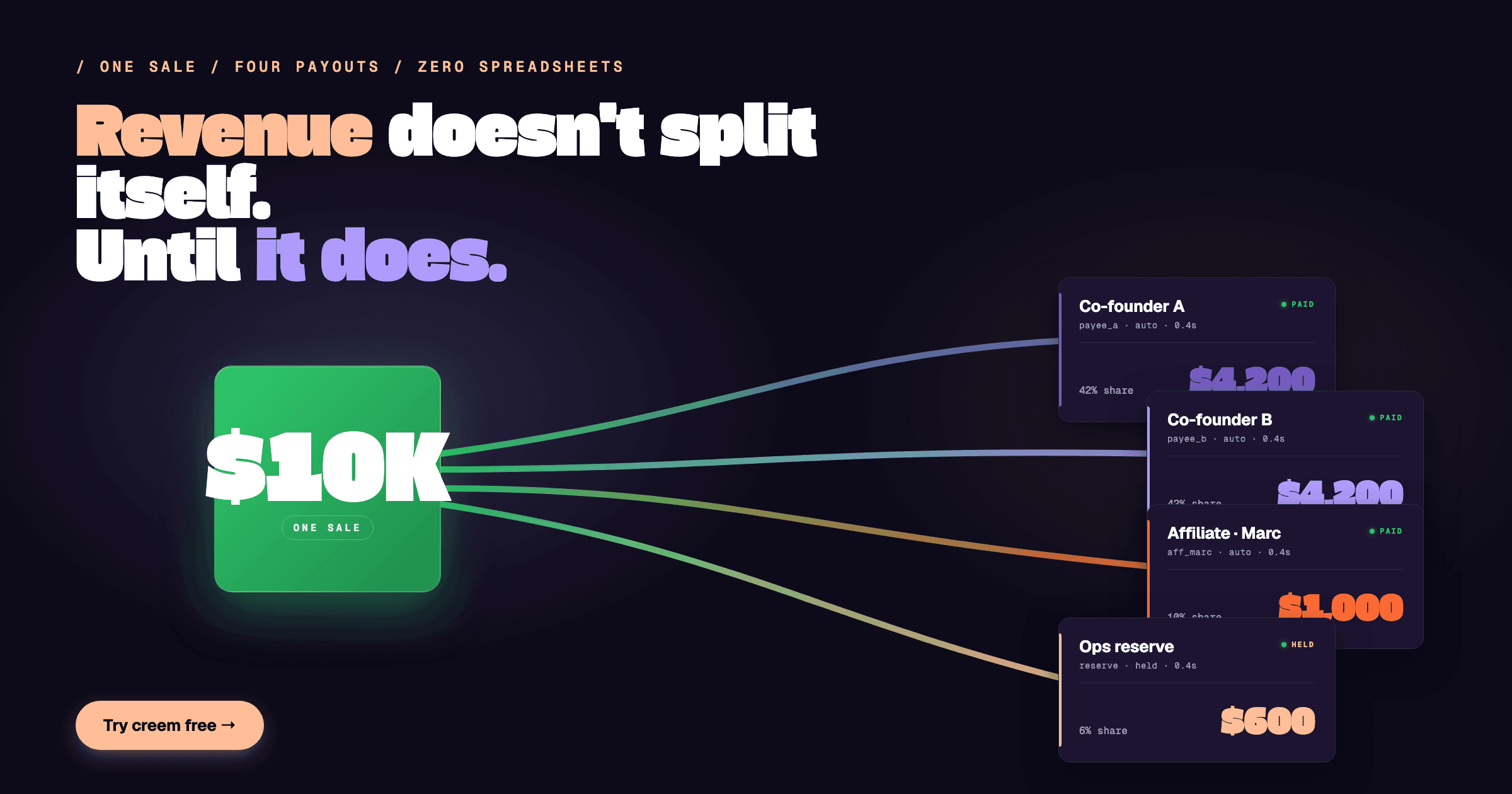
An illustration, not a live dashboard: one sale divided between two co-founders at 42% each, an affiliate at 10% and a 6% operations reserve.
Add each partner share to the pricing worksheet in step 4.
Before launch, make a test purchase through a partner’s link. Confirm that the commission and each split appear against that order at the percentages written in the agreement.
Payout statements rarely match gross sales, because fees, tax, partner shares, refunds and held earnings all come out first. Any tax the buyer paid on top never counted as your earnings.
Reconciliation connects those sales records to the payout statement and the deposit in your bank. Keep separate worksheet columns for:
- Sales and tax: Your price and the buyer’s VAT or sales tax belong in separate columns, because tax is collected for the tax authority.
- Fees: Record transaction fees per order, apart from your price and the tax.
- Partner allocations: Record each share against its order. When a refund reverses that share, enter the reversal as it appears on the order’s record.
- Refunds and disputes: Record any refund or chargeback amount taken from your balance.
- Held and available earnings: Separate money waiting for release from money available for payout.
Match each payout statement to its bank receipt, accounting for any transfer fee or currency conversion. That lets you distinguish a deduction from money that has not arrived yet.
Record both the payout’s processed date and the date it lands in your bank. Model bills may come due while earnings are still held, so budget against the expected bank-arrival date, allowing for release conditions, the minimum withdrawal balance and the payout schedule.
11. Track results and earn renewals
A buyer can open the agent every day and still cancel. Sessions tell you neither whether a draft got approved nor whether a renewal payment cleared. Count approved results and paid renewals separately.
With the proposal-review agent, compare recent drafts and review times with the threshold the buyer agreed in the pilot in step 6. Ask the approver whether drafts needed only final sign-off edits and whether review time fell. Passing your test suite still matters, but it does not tell you whether the agent meets buyers’ current needs.
Keep that feedback alongside:
- Usage per buyer: How many reviews they run and how much of their allowance they consume.
- Support questions: The questions buyers send you after a review comes back.
- Renewal records: Who renews and who leaves.
Calculate subscription renewal rate by taking the subscriptions due for renewal in a period and dividing the number of those that renewed by the total due. For example, 80 renewals out of 100 due this month is 80%. Count repeat credit-pack purchases separately: a buyer topping up credits has not committed to another month.
Separate deliberate cancellations from failed charges before deciding what to fix. A buyer who wants to continue but cannot complete payment has a different problem from someone who no longer finds the reviews useful. Record successful payment recoveries separately so you can see which failed renewals eventually paid.
Review these records the week before a batch of renewals comes due. Heavy usage with repeated requests for clarification points to guidance worth improving. Low usage calls for a buyer conversation before you add features.
Agents versus other expertise products
An agent that reviews sales proposals before they go out is one way to sell your expertise. Someone could also pay to learn how to review proposals themselves, use your checklist or have you personally review their draft.
The buyer’s goal determines the format:
| Product | What the buyer wants | Proposal-review offer |
|---|---|---|
| Course | To learn how you do the review. | Lessons showing how to assess and revise a proposal. |
| Template | A format to fill in on their own. | A proposal outline with a review checklist. |
| Agent | Your method run on their own draft whenever they need it. | Review of their draft against their client’s brief. |
| Coaching or consulting | Your personal advice on a decision. | Help deciding how far to lower the price to win the deal. |
Go through the last few months of client emails or call notes and count how often the same question came up. Frequent requests for your method applied to new drafts give you a reason to maintain an agent. If requests are rare, a course, template or paid call may meet demand without leaving you an agent to keep testing and supporting.
Should you launch your agent now?
Launch when a buyer has committed to a bounded offer that passes your test set, at a price that still covers model usage and support for your heaviest test buyer. If any of those is still a guess, keep testing with the people who asked for help before you open checkout to everyone.
Once those hold, getting paid is the remaining job, and it grows harder as buyers arrive from more countries. Creem is the legal seller on every sale of your agent, so tax, invoices and chargebacks leave your desk while your business income tax stays with you, and payouts reach you in 80+ countries. Your job is to package your expertise into an agent buyers rely on. We built Creem so you get paid for it everywhere, with tax, invoicing and partner payouts in one money path.
Usage-based billing and prepaid credits let charges follow how much buyers actually use the agent. A proposal-review agent that grows from a handful of agency owners to business buyers in many countries keeps one checkout, with tax handled on every sale and no move to seat plans that fight its model costs. Affiliates and co-creators get their share of each sale from that same checkout.
Once your offer passes its test set and a buyer has committed, try Creem and send them the checkout link. The tax on that first sale is already Creem's to file.
FAQs
Do I need to code to sell AI agents?
Checkout can deliver a license key or download after payment without any code. For paid access, use hosted delivery or have someone write an endpoint that listens for payment webhooks and switches access on in your app.
What business models work for selling AI agents?
Charge monthly for weekly users. Sell occasional users prepaid credits so payment arrives before model costs. Offer a one-off price for one sales proposal reviewed before it goes out.
Can you sell AI agents to businesses?
A short paid trial with a fixed end date and an agreed result gives a business buyer a low-risk way in. Terms should name the documents or systems the agent may read and what it retains.